When "NORMAL" is the Warning Sign
- Rebecca Pfinx
- Apr 22
- 2 min read

Clinical Insights
What reticulocytes taught me about reading between the lab lines👇🏼
In functional medicine, we talk a lot about values that fall outside the reference range. High this, low that. Flag it, investigate it, treat it. But one of the most important lessons in clinical lab interpretation isn't about the numbers that scream at you. It's about the numbers that stay suspiciously quiet when they should be loud.
Let me tell you about a pattern I recently worked through with a 22-year-old client that changed how I think about this entirely.
The picture that didn't add up
Her CBC came back with several concerning findings: low MCH, low MCHC, and a significantly elevated RDW of 18.1. In plain terms: her red blood cells were pale, underfilled with hemoglobin, and wildly inconsistent in size. She'd been on the highest quality iron bisglycinate chelate paired with liposomal vitamin C for several months for anemia. Not the cheap stuff! A protocol that should work.
But her numbers had actually gotten worse.
"A normal value is only truly normal if it makes clinical sense given the full picture. When it doesn't, that silence is diagnostic!"
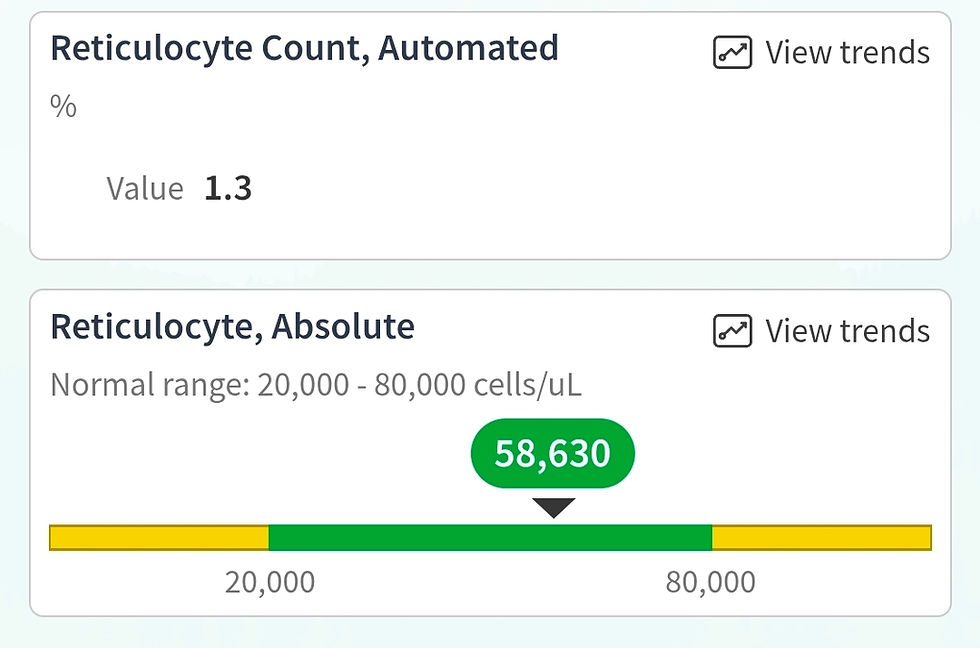
So I ordered reticulocytes. And here's where it gets interesting.
Reticulocyte results
Reticulocyte count 1.3% Normal
Reticulocyte absolute 58,630 Normal
RDW 18.1% High
MCHC 30.8 g/dL Low
MCH 26.4 pg Low
Why "normal" was the most abnormal result on the panel 🤔
Reticulocytes are immature red blood cells, fresh off the production line from the bone marrow. Their count tells us how hard the body is working to replace damaged or deficient cells. Think of them as the emergency response crew.
Given everything else on this panel like the poor cell quality, the hypochromia, the high RDW indicating the bone marrow is struggling to produce consistent cells, her reticulocyte count should have been quite elevated! The bone marrow should have been in overdrive, cranking out new cells to compensate.
It wasn't. It was sitting at a perfectly calm normal value. And that silence told me everything.
"Think of it like a fire alarm that doesn't go off during a fire. The alarm being quiet isn't reassuring but it's the most concerning finding in the room."
In hematology, this is called an inappropriately normal response. The bone marrow isn't being destroyed but it's simply not responding to the demand. Something is suppressing output at the source. That shifts the entire clinical direction from "she needs more iron" to "something is blocking production itself."
What this means clinically👇🏼
A hypoproliferative anemia, where the bone marrow fails to mount an adequate response, points toward very different root causes than a simple iron deficiency picture. This one "normal" has redirected our entire strategy of what to do next. I have left out the rest of her story and labs in the interest of space and reading time. But...
If you have "Normal" blood work and are still dealing with health problems that doctors have not been able to figure out, reach out to me through the contact form or by phone. Let's talk about new directions to try!
Written by Dr. Rebecca · LIVNLIFHealth ·



Comments